Resources
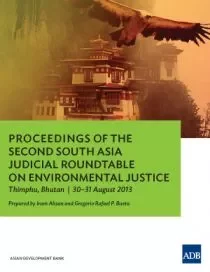
Proceedings of the Second South Asia Judicial Roundtable on Environmental Justice
Adoption of the Thimphu Declaration on Enhancing Environmental Justice in South Asia highlights the Second South Asia Judicial Roundtable on Environmental Justice on 30–31 August 2013 in Thimphu, Bhutan.
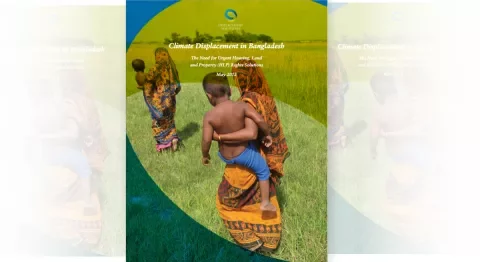
Climate Displacement in Bangladesh, 2012
The report looks into present and future causes of climate displacement in Bangladesh. It examines existing and proposed solutions to climate displacement and relief to climate displaced persons and emphasizes that rights-based solutions, e.g., housing, land and property rights solutions must be utilized in solving this crisis.

The Quest for a United Nations Specialised Agency for the Environment
Recent years have seen intense intergovernmental deliberations on issues’ concerning governance in the field of environment. Their aim has been to address the role of the institutions that provide platforms for international environmental cooperation. There are two main lines of enquiry: the role of regime-specific institutions that cater to sectoral regulatory frameworks (popularly known as multilateral environmental agreements or MEAs); and the role of institutions that are established to follow up on global environmental conferences or a specific environmental task.
Wong Keng Liang - The Lizard King Case
In the instant Appeal, originating from the Magistrate’s Court, the Accused had pleaded guilty without reservation, and indeed unconditionally, to an offence under s.10(a) of the International Trade in Endangered Species Act 2008 (“s.10(a)”), to wit, exporting without permit 95 Boa Constrictor snakes (“the snakes”) which belong to a scheduled species in the Third Schedule, Appendix 2 to the said Act.
Asian Judges Symposium on Environmental Decision Making, the Rule of Law, and Environmental Justice: The Proceedings of the Symposium
The judiciary plays a critical role in environmental enforcement by enunciating principles of environmental law, facilitating the development of environmental jurisprudence, and leading the legal profession to pursue the integration of sustainable development and environmental justice within strong national rule of law systems.
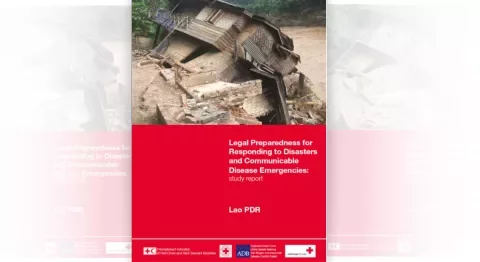
Legal Preparedness for Responding to Disasters and Communicable Disease Emergencies: Study Report - Lao PDR
Laos is prone to a number of different disaster and disease risks such as floods in the Mekong corridor, major droughts, earthquakes, flash floods and storms related to a heavy typhoon season, as well as human influenza pandemic. Having a comprehensive legal framework in place will facilitate fast mobilization and response in the event of an emergency and will contribute to good coordination and information exchange between different humanitarian partners regardless of whether they are local, national or international.
Criminal Procedure Code of Kingdom of Cambodia
This Code of Criminal Procedure aims at defining the rules to be strictly followed and applied in order to clearly determine the existence of any criminal offense. The provisions of this Code shall apply for criminal cases unless there are special rules set forth by separate laws.

Processes of Request for Export or Import of Timber and Non-Timber Forest Products
There are 5 phases for the processes of request for export or import of timber and non-timber forest products. The required timing for getting permission may vary according to nature of requests and the completeness of submitted application form and supported documents.
Sub-Decree on Control of Air Pollution
The purpose of this sub-decree is to protect the quality of the environment quality and public health from air pollutants and noise disturbance through monitoring, curbing and mitigating activities.
Implementation of the Convention on Biological Diversity A retrospective analysis in the Hindu Kush-Himalayan countries
This paper looks at the progress made in the implementation of the CBD and 2010 targets in the eight countries of the Hindu Kush-Himalayan region: Afghanistan, Bangladesh, Bhutan, China, India, Nepal, Myanmar and Pakistan. The paper was commissioned by ICIMOD, an inter-governmental institution mandated for the region, as one of its activities in support of the CBD and the International Year of Biodiversity 2010. Using the national reports to the CBD as the primary source, the paper examines the progress made by the countries in implementing the Convention.