Resources
RIO+20 - Operative Manual
Get travel and event details on the Rio + 20 conference from this handbook .
Rio+20 and the World Congress of Chief Justices, Attorneys General and Auditors General
Despite many international conferences and important developments in environmental policy, law and governance, only insufficient progress has been made towards achieving many of the internationally agreed environmental goals, targets and objectives. Indeed, in implementing environmental law, including Multilateral Environmental Agreements, States have encountered many challenges in their quest for sustainable development and in improving the overall state of the global environment.

Bhutan Declaration
The Second South AsianJudicial Roundtable on Environmental Justice, supported by the Judiciary of Bhutan and the Asian Development Bank was held in Thimphu, Bhutanon 30-31 August 2013. The Conferencebrought together chief justices, judges, court officials and environmental experts from Afghanistan,Bangladesh, Bhutan, India, Maldives,Nepal, Pakistan, and Sri Lanka.
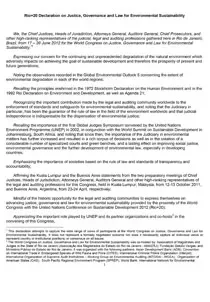
Outcome-Rio+20 and the Declaration of Justice Governance and Law for Environmental Sustainability
Rio+20Declaration on Justice, Governance and Law for Environmental Sustainability
Community Forest Rules, 1993 (Revised Edition)
These Rules provide for the formation of Community Forests Users Groups. Such groups shall be responsible for the managing and protection of community forests established on degraded forest or village waste land (sect. 4.1).
Bhutan Forest Act of 1969
This Act provides for the establishment of Forest Reserves and defines rules applicable to activities in such areas. The 31 sections of the Act are divided into 5 Chapters: Preliminary (I); Reservation of Forests (II); Rights and Concessions (III); Penalties and Procedures (IV); Miscellaneous (V). The present Act aims at consolidating the law relating to forests, the transit of forest produce and duty leviable on timber and other forest produce.
Livestock Act of the Kingdom of Bhutan 1981
A Law for the health protection, development and hygienic utilization of animal resources.
Community Protected Forest Rules, 1990
These Rules provide for the handing over of national forest land to "users' groups" for purposes of conservation of the environment and forest resources.
Disposal of dead animals 1981 (By-law No. 8)
With a view to prevent water pollution and other environmental pollution and to ensure the early detection of diseases, this By-law prohibits to throw any dead animal or parts thereof into rivers, lakes, ponds or other surface waters. If the animal is a Government property or a registered breeding animal the DAHO/DVO shall make a necropsy in order to determine the causes of death. If the animal is a private property, the owner shall inform the DAHO/DVO if he suspects that the death was caused either by a notifiable disease or by a wilful action. Article 5 establishes penalties in case of violation.
Measures to prevent the introduction of infectious and contagious animal diseases from abroad 1981 (By-law No. 3)
This By-law aims at protecting the national livestock against the spreading of diseases of considerable socio-economic importance.