Resources

Environmental Assessment Act, 2000
This Act provides for policies and measures to reduce potential adverse effects of strategic plans, programs, etc. which may have an impact on the environment.
Regulation for the Environmental Clearance of Projects
This Regulation provides for the issuance and enforcement of environmental clearances for individual projects.
River Murray Act
An Act to provide for the protection and enhancement of the River Murray and related areas and ecosystems; and for other purposes.
UNEP & SAARC South Asia Environment Outlook 2009
This report provides an overview of the state of the natural environment in South Asia, including emerging trends, taking into account socio-economic factors.South Asia occupies about 5 percent of the world’s land mass, but is home to about 20 percent of the world’s population. This is expected to rise to about 25 percent by 2025. Three-quarters of South Asia’s population lives in rural areas, with one-third living in extreme poverty (on less than a dollar a day).
UNEP Judicial Handbook on Environmental Law
This handbook is intended to enable national judges in all types of tribunals in both civil law and common law jurisdictions to identify environmental issues coming before them and to be aware of the range of options available to them in interpreting and applying the law. It seeks to provide judges with a practical guide to basic environmental issues that are likely to arise in litigation. It includes information on international and comparative environmental law and references to relevant cases.
UNEP Judicial Handbook Environmenal Law 2005
This handbook is intended to enable national judges in all types of tribunals in both civil law and common law jurisdictions to identify environmental issues coming before them and to be aware of the range of options available to them in interpreting and applying the law. It seeks to provide judges with a practical guide to basic environmental issues that are likely to arise in litigation. It includes information on international and comparative environmental law and references to relevant cases.
Judges & Environmental Law: A Handbook for the Sri Lankan Judiciary
This publication brings together a collection of essays on different aspects and perspectives of the environment and the law. It seeks to complement the knowledge of judges in the enforcement of Sri Lanka’s environmental laws and recognises them as vital in the effectual implementation of environmental legislation and its policies. Despite considerable progress in recent years, much remains to be done to restore and preserve Sri Lanka’s natural resources and its rich biodiversity.
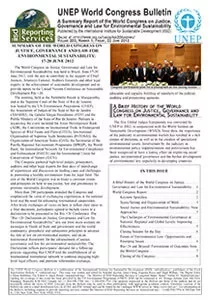
A Summary Report of the World Congress on Justice, Governance and Law for Environmental Sustainability
The World Congress on Justice, Governance and Law for Environmental Sustainability was held in Brazil, from 17-20 June 2012, with the aim to contribute to the support of Chief Justices, Attorneys General, Auditors Generals and other legal experts to the achievement of sustainable development and to provide inputs to the United Nations Conference on Sustainable Development Rio +20.
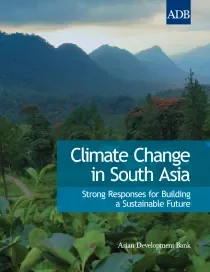
ADB Climate Change in South Asia
ADB's South Asia region is comprised of Bangladesh, Bhutan, India, the Maldives, Nepal, and Sri Lanka, extending from the highlands of the Himalayas to the atolls of the Indian Ocean. It is also home to more than 600 million of the world's absolute poor, who will be most vulnerable to the negative impacts of climate change. As critical sectors such as water, energy, and agriculture are affected, efforts at poverty alleviation and economic development are also threatened.
ADBI Sri Lanka Country Paper (2013)
All the concepts indicated in this document are introduced to Sri Lanka during last last decade and therefore the policies, programmes, projects and strategies have been recently introduced and implemented and so results are pending. To strengthen up these kinds of projects, more attention should be given to conducting awareness programmes to industries, training of relevant officers involved in these fields, providing modern equipment to carry out research and other activities and constructing suitable laboratories and other facilities.