Resources
Rio+20 and the World Congress of Chief Justices, Attorneys General and Auditors General
Despite many international conferences and important developments in environmental policy, law and governance, only insufficient progress has been made towards achieving many of the internationally agreed environmental goals, targets and objectives. Indeed, in implementing environmental law, including Multilateral Environmental Agreements, States have encountered many challenges in their quest for sustainable development and in improving the overall state of the global environment.

Bhutan Declaration
The Second South AsianJudicial Roundtable on Environmental Justice, supported by the Judiciary of Bhutan and the Asian Development Bank was held in Thimphu, Bhutanon 30-31 August 2013. The Conferencebrought together chief justices, judges, court officials and environmental experts from Afghanistan,Bangladesh, Bhutan, India, Maldives,Nepal, Pakistan, and Sri Lanka.
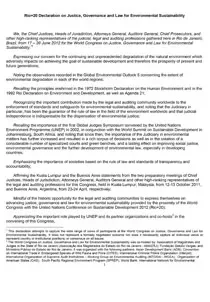
Outcome-Rio+20 and the Declaration of Justice Governance and Law for Environmental Sustainability
Rio+20Declaration on Justice, Governance and Law for Environmental Sustainability
Electricity Act, 2001
The purpose of this Act is to provide for the restructuring of the power supply industry and the possible participation of the private sector, and by providing mechanisms for licensing and regulating the operations of power companies.This Act provides for the establishment of the Bhutan Electricity Authority and for its powers and functions.
Seeds Act of Bhutan, 2000
An Act to regulate import and export of Agricultural seeds, to prevent introduction of plant pests and diseases and to promote seed industry in the country aimed at enhancing rural income and livelihood.
Environmental Assessment Act, 2000
This Act provides for policies and measures to reduce potential adverse effects of strategic plans, programs, etc. which may have an impact on the environment.
Regulation for the Environmental Clearance of Projects
This Regulation provides for the issuance and enforcement of environmental clearances for individual projects.
Lease Forest Rules, 1990
These Rules make provision for the leasing of selected degraded forests alienated from the National Forests to individuals, groups of individuals or government institutions. The forest will be leased for not more than 25 years (rule 6.1). The lessee shall develop the forest within a period of three years (6.ule 6.2). The lessee shall apply for a permit to utilize the forest produce (rule 9.1). The lessee may transfer lease rights (rule 10.1). A new agreement will be made between the new lessee and the Divisional Forest Officer (rule 10.2). (12 rules and 3 Schedules)
Environmental Assessment Act, 2000
This Act provides for policies and measures to reduce potential adverse effects of strategic plans, programs, etc. which may have an impact on the environment.
Regulation for the Environmental Clearance of Projects
This Regulation provides for the issuance and enforcement of environmental clearances for individual projects.