Resources

ASEAN Handbook on International Legal Cooperation in Trafficking in Persons Cases
This Handbook forms part of a collection of tools and resources developed by and for the Member States of ASEAN, through the Asia Regional Project on Trafficking in Persons (ARTIP), aimed at strengthening national and regional responses to TIP. I take this opportunity to urge relevant officials of ASEAN Member States to familiarize themselves with these tools and resources, which now include a comprehensive series of training materials for criminal justice professionals including judges and prosecutors, investigators and front line law enforcement officials.
ADB Climate Change in South Asia
ADB's South Asia region is comprised of Bangladesh, Bhutan, India, the Maldives, Nepal, and Sri Lanka, extending from the highlands of the Himalayas to the atolls of the Indian Ocean. It is also home to more than 600 million of the world's absolute poor, who will be most vulnerable to the negative impacts of climate change. As critical sectors such as water, energy, and agriculture are affected, efforts at poverty alleviation and economic development are also threatened.
Green Benches: What can the People's Republic of China Learn from Environment Courts of Other Countries?
The rapid economic growth of the People’s Republic of China (PRC) over the last 30 years has generated many environmental problems and a concomitant rise in the number of environmental disputes. Until 1989, legal cases arising from these disputes were usually heard in the people’s courts of general jurisdiction. In that year, however, the development of the environment court system accelerated, leading to the creation of 11 such courts for pilot cases, a sign of the high priority the PRC has given to environmental protection over the past two decades.
Asian Judges: Green Courts and Tribunals, and Environmental Justice
Asia and the Pacific has experienced dramatic environmental change over the last 10-20 years. While developing member countries (DMCs) began adopting environmental policy and regulatory frameworks beginning in the early 1970s, many environmental challenges have still not been suffi ciently addressed in policy and regulatory frameworks.
Second ASEAN Chief Justices' Roundtable on Environment: The Proceedings
Describes how international and regional cooperation among the various judiciaries can shape an effective rule-of-law system, capable of fostering strong environmental governance.
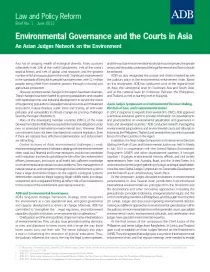
Environmental Governance and the Courts in Asia: An Asian Judges Network on the Environment
Asian chief justices and judges recognize that they have much to gain by exchanging experiences with judges across borders. Their professional ties with fellow judges are often strong, given their shared professional challenges. ADB has recognized the unique and distinct leadership role the judiciary plays in the environmental enforcement chain. This brief is a summary of ADB's work with the Asian courts at the regional level, subregional level (South East and South Asia), and national level (Indonesia, Malaysia, Pakistan, the Philippines, and Thailand).
Inaugural ASEAN Chief Justices' Roundtable on Environment: The Proceedings
Formulation of "A Common Vision on Environment for ASEAN Judiciaries" statement was one of the highlights of the Inaugural ASEAN Chief Justices' Roundtable on Environment.
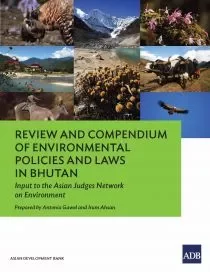
Review and Compendium of Environmental Policies and Laws in Bhutan: Input to the Asian Judges Network on Environment
ADB, in partnership with Bhutan's Royal Court of Justice, convened the Second South Asia Judicial Roundtable on Environmental Justice to discuss shared environmental challenges, common experiences, and ways to further cooperation. This Review and Compendium of Environmental Policies and Laws in Bhutan aims to facilitate access to information for all stakeholders engaged in the environment sector, in particular for the Judiciary and administrative officials responsible for overseeing the protection of the country’s natural resources.
FIU Operational Effectiveness—Findings and Observations from the Asian Development Bank Perspective
This paper examines the specific findings on the level of technical compliance and operational effectiveness of the national financial intelligence units (FIUs) in 55 members of the Asian Development Bank under the mutual evaluations carried out by the Financial Action Task Force and its regional bodies (also referred to as FATF-style regional bodies) in connection with the current international standard for combating money laundering and terrorism financing (i.e. the FATF Recommendations). It also provides three observations for enhancing the use of financial information and intelligence. [Abstract]
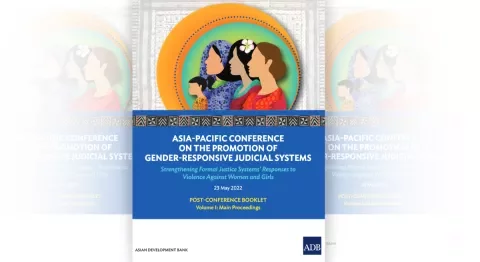
Asia-Pacific Conference on the Promotion of Gender-Responsive Judicial Systems Post-Conference Booklet Volume 1
Strengthening Formal Justice Systems’ Responses to Violence Against Women and Girls POST-CONFERENCE BOOKLET Volume I: Main Proceedings 23 May 2022