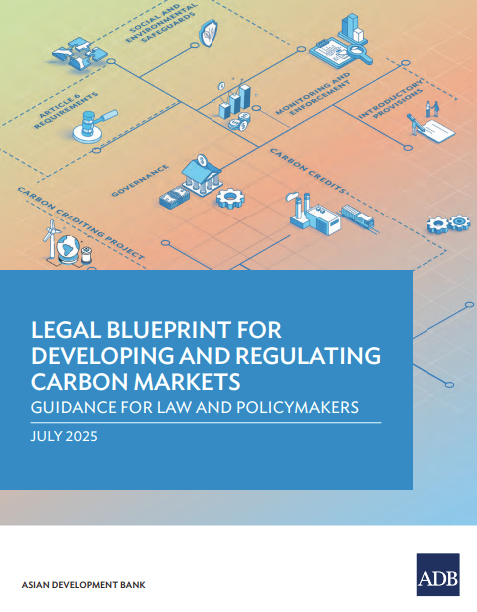
The Legal Blueprint for Developing and Regulating Carbon Markets, published by the Asian Development Bank (ADB) in July 2025, provides guidance for lawmakers and policymakers designing legal and regulatory frameworks for carbon markets and carbon crediting activities.
The Legal Blueprint examines key legal, regulatory, and governance building blocks that support participation in carbon markets, including domestic carbon crediting schemes and engagement with international carbon crediting standards and mechanisms. By promoting legal clarity, environmental and social integrity, and alignment with international standards, it aims to support enabling frameworks for carbon finance and investment while recognizing the need for flexibility and tailoring to national circumstances.
To support navigation of the Legal Blueprint, ADB’s Law and Policy Reform Program developed this interactive companion tool. The tabs below provide different ways to explore the Blueprint, including policy design considerations, decision pathways, core legal requirements, and legislative architecture.
To learn more about these interactive tools, please visit the “How to Use This Tool” tab.
For any questions, please contact carbonmarkets@adb.org.
This tool provides concise, practical guidance on the key components of the Legal Blueprint for Developing and Regulating Carbon Markets, helping users navigate major concepts, legal frameworks, and policy considerations related to carbon markets. It highlights the most important sections, decisions, and building blocks in a more accessible and streamlined format.
Please note: The Legal Blueprint focuses primarily on the supply side of carbon markets and does not address carbon credit demand mechanisms such as carbon taxes, emissions trading schemes, or compliance crediting systems. Users seeking a more comprehensive understanding are encouraged to consult the full resource.
User tips:

Rotate your device
This interactive table is best viewed in landscape mode. Please tilt your phone sideways.
This interactive figure presents a high-level sequence of considerations for policymakers developing legal frameworks for carbon crediting and engagement in carbon markets. Click each step to explore why it matters, key policy questions, and related next steps.
Steps for Developing Legal Frameworks for Carbon Crediting and Engagement in Carbon Markets
This interactive tool is designed to help policymakers, regulators, and stakeholders explore possible approaches to regulating carbon crediting activities within a country. Starting from the first question, select the response that best reflects national circumstances to reveal the next relevant consideration and possible regulatory pathway.
The decision tree is intended as a practical navigation aid alongside the Legal Blueprint for Carbon Markets and should be read together with the broader legal, institutional, and policy considerations discussed throughout the publication.
Are there carbon crediting projects already taking place in the country? And/or is there emissions reduction or removal potential from carbon crediting?
Does the country have significant domestic mitigation needs to meet its NDC?
Is the country prioritizing scaling domestic carbon crediting activities at this time? This decision would need to be informed by policy considerations relating to the role of carbon financing in achieving the country's NDC and broader sustainable development objectives.
Do carbon crediting projects already operating require additional regulatory oversight (or, if not in existence yet, are they likely to require this oversight)? (E.g., approval requirements to ensure alignment to the country's laws and Sustainable Development Goals, additional safeguards to protect the rights of Indigenous Peoples and local communities, protection and promotion of biodiversity, and supporting sustainable livelihoods.)
The ADB DMC should consider establishing a legal framework for regulating carbon crediting projects conducted within the country, defining in particular the processes and procedures related to participation in Article 6 of the Paris Agreement. It should carefully consider the potential benefits and risks involved in this approach, including the risk of overselling. It should also develop a national Article 6 strategy to ensure its participation contributes to the implementation of its NDC and long-term low-emission development strategy, if it has submitted one, and the long-term goals of the Paris Agreement. The type of legal framework that is chosen will likely depend on additional considerations:
Does the ADB DMC have the financial, human, and technical resources and capabilities to establish a domestic carbon crediting scheme?
Are international carbon crediting schemes and their methodologies unlikely to be appropriate and applicable to the ADB DMC's national context?
Source: ADB. 2025. Legal Blueprint for Developing and Regulating Carbon Markets.
Rotate your device
This interactive table is best viewed in landscape mode. Please tilt your phone sideways.
| Legislative Part | Likely Requirements for Both | Additional Domestic Scheme Requirements | Additional Requirements When Using International Standards |
|---|---|---|---|
| Part 1: Introductory Provisions Blueprint, p. 19 |
| — | — |
| Part 2: Governance Blueprint, p. 31 |
| — | — |
| Part 3: Carbon Projects Blueprint, p. 41 |
|
|
|
| Part 4: Carbon Credits Blueprint, p. 61 |
|
|
|
| Part 5: Article 6 Blueprint, p. 79 |
| — | — |
| Part 6: Social and Environmental Safeguards Blueprint, p. 93 |
| — | — |
| Part 7: Monitoring and Enforcement Blueprint, p. 101 |
|
| — |
Source: ADB. 2025. Legal Blueprint for Developing and Regulating Carbon Markets.
Rotate your device
This interactive table is best viewed in landscape mode. Please tilt your phone sideways.
This table maps key building blocks commonly found within different parts of carbon market legal frameworks and identifies their constituent elements. Select a legislative part to explore related building blocks and click the information icons for brief explanatory text.
Source: ADB. 2025. Legal Blueprint for Developing and Regulating Carbon Markets.