Environmental Protection and the Judiciary
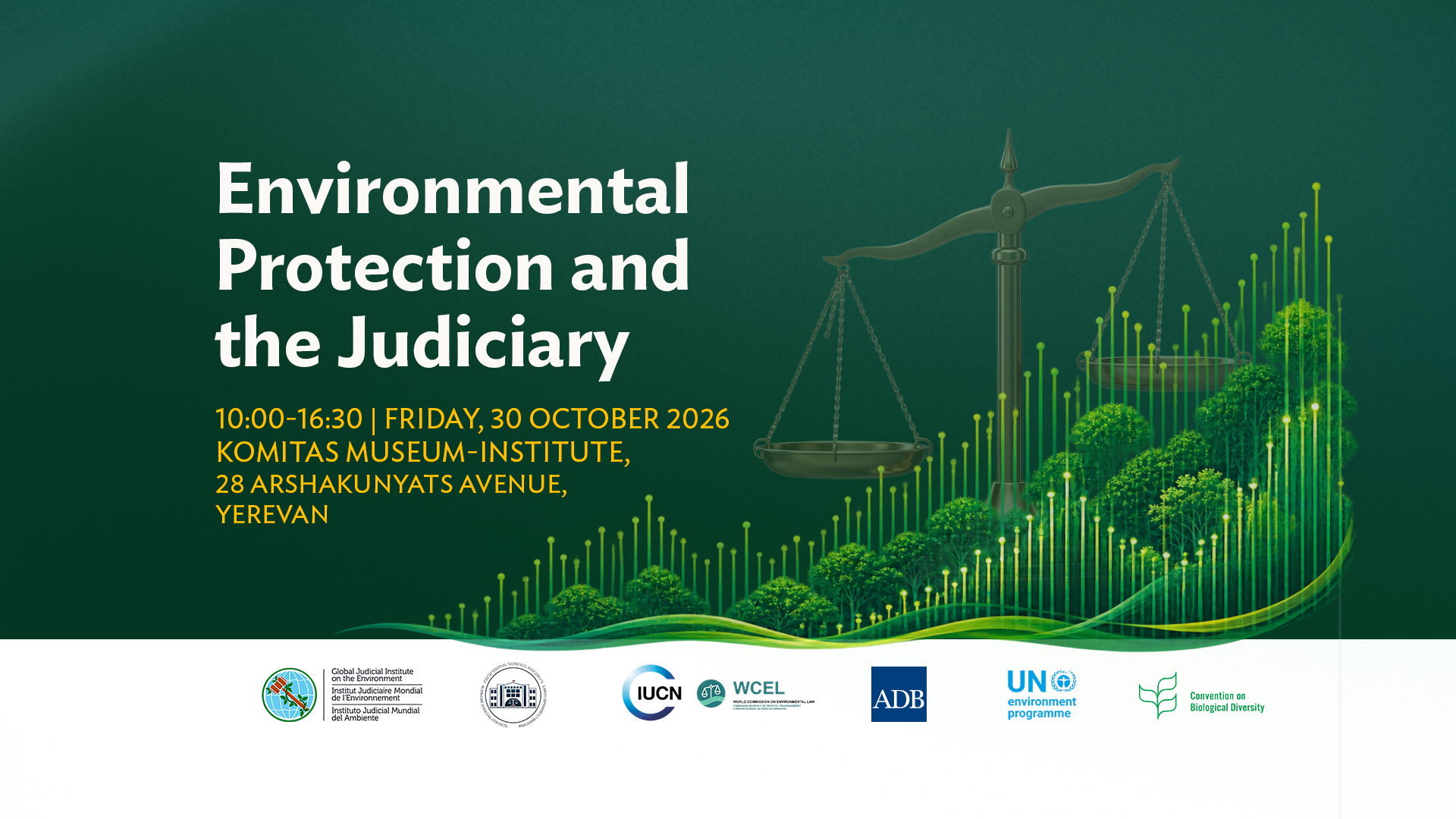
The judicial colloquium on environmental protection and judiciary will convene judges from Armenia and around the world to exchange insights on the role of courts in contributing to the protection of nature and strengthening the environmental rule of law, share experiences and expertise on key principles and good practices, and collectively reflect on the developments and outcomes of the 17th Conference of the Parties (CBD COP17) to the United Nations Convention on Biological Diversity in Yerevan, Armenia.
The discussion will provide an opportunity to take stock of recent advances in environmental legislation and the role of the judiciary in its effective interpretation, as well as in supporting implementation and enforcement. These developments include the recent adoption of the Armenia’s Law on Climate 2026, amendment of Armenia’s framework for environmental impact assessment (EIA) to systematically account for biodiversity in 2023, and the upgraded ambition to double the coverage of protected areas by 2030 enshrined by the Law on Specially Protected Areas. Participants will also have an opportunity to explore avenues to improve the protection of key biodiversity areas and ecosystems.
The exchanges will also be situated within the broader normative and legal evolution of biodiversity governance, bringing together a diverse range of international speakers from across the globe against the backdrop of CBD COP17. Speakers will be invited to share experiences and expertise in judicial efforts to advance ecosystem protection, discuss emerging trends and principles in biodiversity-related adjudication, and explore potential pathways for courts to improve the environmental rule of law.
Objectives
- Identify and unpack the drivers and dynamics of environmental law in Armenia: the event is designed to reflect the specific circumstances of Armenia, with a particular emphasis on biodiversity conservation, climate change, and water governance, providing panelists with an opportunity to take stock of the COP17 host country’s progress and plans for upgrading ecosystem protection.
- Improving awareness of the judicial toolkit of biodiversity protection: the discussions will enrich participants’ knowledge of the toolkit of measures available to judges and courts to strengthen biodiversity protection and the environmental rule of law, encompassing both enduring elements such as planning and permitting decisions and emerging aspects such as the rights of nature.
- Enhancing understanding of the role of courts across the judicial lifecycle of biodiversity protection: the event will chart the historical role and evolution of courts in ecosystem protection and the environmental rule of law, encompassing the judicial lifecycle of the interpretation of rules and principles, their practical application and implementation, and enforcement and remedies.
Audience
Armenian and international judges, government officials, legal professionals and other stakeholders.
AGENDA
10:00 – 10:30 Opening Speeches: Surveying the Key Elements of the Environmental Rule of Law
This opening session will set the conceptual foundations for the discussion, introduce recent developments in environmental law within Armenia and at the international level, and explore the role of courts in environmental protection. It will also highlight Armenia’s leadership on biodiversity in hosting this dialogue and CBD COP17.
Chair: Secretariat of the Convention on Biological Diversity (tbc)
Opening remarks:
- Astrid Schomaker, Executive Secretary, Convention on Biological Diversity (tbc)
- Hon. Justice Artur Atabekyan, Chairman, Supreme Judicial Council of Armenia
- H.E. Dr. Srbuhi Galyan, Minister of Justice of Armenia
- Hon. Justice Antonio Herman Benjamin, National High Court of Brazil and President of the Global Judicial Institute on the Environment
- H.E. Hambardzum Matevosyan, COP17 President and Minister of Environment, Armenia (tbc)
- Lyaziza Sabyrova, Country Director, Armenia Resident Mission, Asian Development Bank
Introduction to the objectives and format of the forum:
- Christina Pak, Assistant General Counsel (Law and Policy Reform), Asian Development Bank
Group Photo
10:30 – 11:30 Panorama: Environmental Law around the World - Objectives, Principles and Instruments
This panorama will examine how courts define, interpret, apply and enforce the environmental rule of law. This will introduce the prevailing principles of international environmental law, the suite of instruments used in its practical implementation, and the role of judges and courts in this process.
Chair: Hon. Yeranuhi Tumanyants, Member of the Supreme Judicial Council of Armenia
- Hon. Justice Antonio Herman Benjamin, National High Court of Brazil, President of the Global Judicial Institute on the Environment
- Hon. Karen Tumanyan, Member of the Supreme Judicial Council of Armenia
- Patricia Kameri-Mbote, Director, Law Division, UN Environment Programme
- Hon. Justice Brian Preston, Land and Environment Court of New South Wales, Australia
- Professor Dr. Luc Lavrysen, Former President of Constitutional Court of Belgium and Professor Emeritus at Ghent University
Q&A
11:30 – 12:30 Panel I: Examining the Toolkit – the Legal System of Climate, Forests, Water, Biodiversity and Pollution and Waste
The environmental rule of law is grounded in the regulation of climate change, forests, water, and pollution and waste. While these are deeply interconnected, they are governed through distinct sets of instruments. This introductory session will explore the commonalities and differences between these legal domains, provide an overview of their essential elements, and situated them within real-world examples and practices.
This panel will examine how courts adjudicate across various legal domains, how to reduce tensions and ensure coherence across frameworks, how to catalyze a shift from fragmentation to integration in the environmental rule of law, and their role in strengthening biodiversity and ecosystem protection.
Chair: Hon. Justice Karen Zarikyan, Head of Administrative Court of Armenia
- Pollution and Waste: Hon. Justice Prakash Shrivastava, Chairperson, National Green Tribunal of India
- Climate: Hon. Deputy Chief Justice Ambeng Kandakasi, Supreme and National Courts of Papua New Guinea
- Water: Professor Dr. Luc Lavrysen, Former President of Constitutional Court of Belgium and Professor Emeritus at Ghent University
- Forests: Nick Bryner, Professor of International Environmental Law, Louisiana State University
- Biodiversity: Tim Scott, Senior Environmental Policy Advisor, United Nations Development Programme
- Judicial Education: Hon. Dr. Tatev Sujyan, Rector of the Academy of Justice of Armenia
Q&A
12:30 – 14:00 Lunch Break
14:00 – 15:00 Panel II – Access to Justice: Comparative Insights and Armenian Perspectives
The transparency, integrity, and equity of environmental laws depend on the provision of access to justice. This panel will provide a platform to collectively examine the core pillars of the right to access, request and receive environmental information, legal avenues for multi-stakeholders, public participation in environmental decision-making, and the ability to resolve disputes, register grievances and seek remedial action.
Chair: Hon. Dr. Tatev Sujyan, Rector of the Academy of Justice of Armenia
- Hon. Justice Sapana Malla, Supreme Court, Nepal
- Hon. Justice Nongmeikapam Kotiswar Singh, Supreme Court of India
- Hon. Justice Liza Grigoryan, Judge of the Court of Cassation of Armenia
- Hon. Justice Anne Omollo, Environment and Land Court, Kenya
- Hon. Justice Brian Preston, Land and Environment Court of New South Wales, Australia
Q&A
15:00 – 16:00 Panel III – Implementation, Administration and Enforcement
Environmental laws must be implemented and enforced to be effective. However, the institutional capacity to enact adopted measures is challenging. This panel discussion will explore the variety of avenues for ensuring compliance, the toolkit of enforcement measures available to courts, and the distinction and interplay between administrative and criminal enforcement in the environmental rule of law. It will also provide a platform for collectively examining both enduring challenges such as how to bridge legal commitments and their practical enforcement, as well as rising trends such as the increasing attention to crimes that affect the environment.
Chair: Hon. Justice Liza Grigoryan, Judge of the Court of Cassation of Armenia
- Hon. Justice Kari Kuusiniemi, President, Supreme Administrative Court of Finland and President of European Forum of Judges for the Environment
- Hon. Justice Karen Zarikyan, Head of Administrative Court of Armenia
- Hon. Justice Eufrazina Paiva, Supreme Council of the Judiciary of Angola
- Hon. Justice Bambang Mulyono, Chief Judge of The High Court of Medan, North Sumatera, Indonesia
- Hon. Justice Ananda Bhattarai, Supreme Court of Nepal (retd)
Q&A
16:00 – 16:15 Closing Reflections and Next Steps
- Hon. Justice Antonio Herman Benjamin, National High Court of Brazil and President of the Global Judicial Institute on the Environment
- Hon. Yeranuhi Tumanyants, Member of the Supreme Judicial Council of Armenia
- Narine Avetisyan, Principal Private Sector Development Officer, Asian Development Bank
16:15 – 17:00 Networking Coffee/Tea
SPEAKER BIOGRAPHIES
Speakers in agenda order

Astrid Schomaker
Executive Secretary, Convention on Biological Diversity (CBD)
Astrid Schomaker has been Executive Secretary of the Convention on Biological Diversity since 2024, when she was appointed by the UN Secretary-General. She previously spent more than 30 years at the European Commission, most recently as Director for Green Diplomacy and Multilateralism and, before that, Director for Global Sustainable Development in the Directorate-General for Environment. Her earlier Commission roles covered EU–US relations, regulatory cooperation with Japan, relations with the Andean Community, and the marine environment and water industry. She studied English, history and law in Hamburg and Norwich and holds an LLM from the Free University of Brussels.

Hon. Justice Artur Atabekyan
Chairman, Supreme Judicial Council of the Republic of Armenia
Hon. Justice Artur Atabekyan has been Chairman of the Supreme Judicial Council of the Republic of Armenia since December 2024. The Council is the constitutional body that safeguards judicial independence and oversees the nomination, evaluation and discipline of judges. He is also a judge of the Civil Chamber of the Court of Cassation. He took the bench in 2012 at the Court of General Jurisdiction of Lori Province and later served on the Bankruptcy Court, which he chaired from 2022.

H.E. Dr. Srbuhi Galyan
Minister of Justice of the Republic of Armenia
H.E. Dr. Srbuhi Galyan has been Minister of Justice of the Republic of Armenia since November 2024 and was reappointed in the government formed in August 2026. She previously served as Deputy Prosecutor General (2020–2024), where she coordinated work on the confiscation of illicit assets, and as Deputy Minister of Justice (2019–2020). Earlier, she worked at Armenia’s Special Investigative Service. She holds law degrees and a PhD in law from Yerevan State University, where she has taught criminal law since 2015, and also teaches at the Academy of Justice.

Hon. Justice Antonio Herman Benjamin
Justice, National High Court of Brazil (STJ); Chair, Model Forest Act Initiative (MoFAI); President, Global Judicial Institute on the Environment
Hon. Justice Antonio Herman Benjamin is a Justice of the National High Court of Brazil (STJ), where he served as Chief Justice and President of the National High Court of Brazil from 2024 to 2026. He is the founder and President of the Global Judicial Institute on the Environment and chairs the Model Forest Act Initiative (MoFAI). A former public prosecutor in São Paulo, where he headed the Environmental Protection Division, he co-drafted landmark Brazilian laws including the Crimes Against the Environment Act (1998) and the Forest Code (2012). He has chaired the IUCN World Commission on Environmental Law and received the 2015 Elisabeth Haub Prize for Environmental Law.

H.E. Hambardzum Matevosyan
President of CBD COP17; Minister of Environment of the Republic of Armenia
H.E. Hambardzum Matevosyan is Minister of Environment of the Republic of Armenia and President of CBD COP17. He was appointed Minister in July 2025 and reappointed in the government formed in August 2026. He previously served as Chief Adviser to the Prime Minister (2023–2025), Deputy Prime Minister (2021–2022) and Governor of Armavir Province (2018–2021). He studied at San Diego State University, specializing in international security and conflict resolution.

Lyaziza Sabyrova
Country Director, Armenia Resident Mission, Asian Development Bank (ADB)
Dr. Lyaziza Sabyrova leads the ADB’s operations and activities in Armenia, and is a leading expert in economics, regional cooperation, and strategy in Central Asia and the Caucasus. She has over 30 years of professional experience, including two decades with the ADB. She joined ADB in September 2000 as Economist in the former AEWU and held increasingly responsible positions in Operations. From 2006 to 2008, she was posted as a Senior Economist at Kyrgyz Republic’s Resident Mission. She was promoted to Principal Regional Economist in June 2015 where she led country partnership strategies, economic and knowledge work, and the institutional strengthening of the CAREC Institute. Ms. Sabyrova holds a Doctorate and Master’s degree in Economics from Indiana University, United States. She also holds a Diploma in Political Economy from Kazakh State University, Kazakhstan.

Christina Pak
Head, MoFAI Secretariat; Assistant General Counsel (Law and Policy Reform), Asian Development Bank (ADB)
Christina Pak is Assistant General Counsel (Law and Policy Reform) at the Asian Development Bank (ADB) and heads the MoFAI Secretariat. She leads ADB’s Law and Policy Reform Program, which delivers legal and judicial reform technical assistance across Asia and the Pacific, with a portfolio covering environmental protection and climate change, gender equality and private sector development. She has also served as ADB project counsel and as its Accountability Mechanism Policy Counsel. She sits on the Steering Committee of the IUCN World Commission on Environmental Law and is admitted to practise in New York and New Jersey.

Hon. Yeranuhi Tumanyants
Member, Supreme Judicial Council of the Republic of Armenia
Hon. Yeranuhi Tumanyants is a member of the Supreme Judicial Council of the Republic of Armenia, the constitutional body that safeguards the independence of courts and judges. She previously served as Deputy Minister of Justice. A specialist in civil and administrative law, she holds a PhD in Law from the Public Administration Academy of Armenia. Her earlier work includes projects on the 2015 constitutional referendum and public oversight of the 2017 parliamentary elections, and she has written a number of articles and manuals.

Hon. Karen Tumanyan
Member of the Supreme Judicial Council of Armenia
Hon. Karen Tumanyan is a Member of the Supreme Judicial Council of Armenia since 2024. Before joining the Supreme Judicial Council, Karen Tumanyan was recognized for his legal expertise and was nominated by the Council for senior judicial positions, including the Anti-Corruption Chamber of the Court of Cassation. He has also contributed to legal scholarship, including work on constitutional and environmental law issues in Armenia.

Patricia Kameri-Mbote
Director, Law Division, United Nations Environment Programme (UNEP)
Patricia Kameri-Mbote is Director of the Law Division at the United Nations Environment Programme (UNEP), which leads UNEP’s work on environmental law, governance and multilateral environmental agreements. She was previously Professor of Law at the University of Nairobi, where she taught for more than 30 years and served as Dean of the School of Law. An Advocate of the High Court of Kenya and Senior Counsel, she holds doctoral and master’s degrees in law from Stanford University and a higher doctorate from the University of Nairobi. Her work spans environmental and natural resources law, property law, human rights and women’s law.

Hon. Justice Brian J. Preston
Chief Judge, Land and Environment Court of New South Wales, Australia
Hon. Justice Brian J. Preston AO SC has been Chief Judge of the Land and Environment Court of New South Wales since 2005. Before his appointment, he was a senior counsel practicing mainly in environmental, planning and administrative law, and earlier principal solicitor at the Environmental Defender’s Office NSW. He has taught postgraduate environmental law for more than 30 years, wrote Australia’s first book on environmental litigation and has published more than 160 articles and chapters. He is a founding member of the Global Judicial Institute on the Environment and chairs the Environmental Law Committee of LAWASIA.

Professor Dr. Luc Lavrysen
Former President, Constitutional Court of Belgium; Professor Emeritus, Ghent University
Professor Dr. Luc Lavrysen is a former President of the Constitutional Court of Belgium and Professor Emeritus of Environmental Law at Ghent University, where he directed the Centre for Environmental and Energy Law. He became a judge of the Constitutional Court in 2001 and its Dutch-speaking President in 2020. He co-founded the European Union Forum of Judges for the Environment (EUFJE) in 2004 and was its President for 17 years until 2025. He is a founding member of the Global Judicial Institute on the Environment and a member of the IUCN World Commission on Environmental Law.

Hon. Justice Karen Zarikyan
President, Administrative Court of the Republic of Armenia
Hon. Justice Karen Zarikyan is President of the Administrative Court of the Republic of Armenia, which hears public law disputes, including those between individuals and state bodies. He has been a judge of the Court since 2013 and has spent his whole legal career there, joining in 2008 as a clerk and later serving as Adviser to the President of the Court. He holds bachelor’s and master’s degrees in law from the Russian-Armenian (Slavonic) University and a Candidate of Legal Sciences degree.

Hon. Justice Prakash Shrivastava
Chairperson, National Green Tribunal of India
Hon. Justice Prakash Shrivastava has been Chairperson of the National Green Tribunal of India, the specialized tribunal for environmental disputes, since August 2023. He was previously Chief Justice of the Calcutta High Court (2021–2023) and a judge of the Madhya Pradesh High Court from 2008. For about six years from 2015, he was also Commissioner for the Welfare of the Victims of the Bhopal Gas Leak Disaster. Before his elevation, he practiced before the Supreme Court of India in tax, civil and constitutional law.

Hon. Deputy Chief Justice Ambeng Kandakasi
Deputy Chief Justice, Supreme and National Courts of Papua New Guinea
Hon. Deputy Chief Justice Ambeng Kandakasi has been Deputy Chief Justice of the Supreme and National Courts of Papua New Guinea since 2018 and a judge of those courts since 2000. He is leading the establishment of a specialist resources, environment and climate change track in the National Court and the training of judges and lawyers in the environmental rule of law. He sits on the governing councils of the Global Judicial Institute on the Environment and the Australasian Institute of Judicial Administration. An accredited mediator, he has chaired the PNG Judiciary’s Alternative Dispute Resolution Committee since 2001 and is Vice President of the Asia Pacific Mediation Forum.

Nicholas Bryner
MoFAI Rapporteur; Professor of Law, Louisiana State University
Nicholas (Nick) Bryner is Professor of Law at Louisiana State University, where he directs the Climate Change Law and Policy Project, and serves as Rapporteur of the Model Forest Act Initiative. He teaches environmental, natural resources, energy and administrative law. He was previously an Emmett/Frankel Fellow in Environmental Law and Policy at UCLA School of Law and a Visiting Associate Professor at George Washington University Law School. He holds an LLM in Environmental and Energy Law from George Washington University, as well as a JD and an MA in Latin American and Hemispheric Studies.

Tim Scott
Senior Environmental Policy Advisor, United Nations Development Programme (UNDP)
Tim Scott is a Senior Environmental Policy Advisor for the United Nations Development Programme (UNDP) in New York. He has fifteen years of experience coordinating country, regional and global initiatives, supporting the design, financing, and implementation of sustainable development policies with the organization, and has worked across a variety of portfolios in nature, climate, energy, the green economy, and environmental mainstreaming. He holds an MA from the University of Virginia.

Hon. Dr. Tatev Sujyan
Rector, Academy of Justice of the Republic of Armenia
Hon. Dr. Tatevik (Tatev) Sujyan has been Rector of the Academy of Justice of the Republic of Armenia, which trains Armenia’s judges, prosecutors and other justice professionals, since May 2026. She spent more than ten years at the Court of Cassation, including in its legal expertise service, and has served as an adviser to the Minister of Justice and on the Judges’ Performance Evaluation Commission. An Associate Professor, she teaches criminal procedure at Yerevan State University and has published on appellate and cassation review.

Hon. Justice Sapana Pradhan Malla
Justice, Supreme Court of Nepal
Hon. Justice Sapana Pradhan Malla is the most senior Justice of the Supreme Court of Nepal, where she has sat since 2016, and served as Acting Chief Justice in 2026, the second woman to lead Nepal’s judiciary. Her judgments have set precedents on constitutional, environmental and human rights issues, particularly gender justice. Before joining the bench she spent nearly three decades as a lawyer and rights advocate, co-founding the Forum for Women, Law and Development and litigating public interest cases on women’s rights and on environmental issues such as water pollution and marble quarrying. She was a member of Nepal’s Constituent Assembly and has served as Secretary General of the Global Judicial Institute on the Environment.

Hon. Justice Nongmeikapam Kotiswar Singh
Justice, Supreme Court of India
Hon. Justice Nongmeikapam Kotiswar Singh is a Judge of the Supreme Court of India and the first judge from Manipur to sit on the Court. He was previously Chief Justice of the High Court of Jammu & Kashmir and Ladakh, a judge and Acting Chief Justice of the Gauhati High Court, and a judge of the High Court of Manipur. His judgments span constitutional, criminal, administrative and environmental law, including rulings on water pollution and public health. Before his elevation in 2011, he practiced before the Supreme Court and the Gauhati High Court and served as Advocate General of Manipur.

Hon. Justice Liza Grigoryan
Judge of the Court of Cassation of the Republic of Armenia
Hon. Justice Liza Grigoryan is a judge and member of the Court of Cassation of Armenia, and has a longstanding career within the judicial system spanning more than three decades. Her expertise encompasses transparency, integrity, and women’s rights. She graduated in Law from Yerevan State University.

Hon. Justice Anne Abongo Omollo
Judge, Environment and Land Court of Kenya
Hon. Justice Anne Abongo Omollo is a Judge of the Environment and Land Court of Kenya, sitting in Nairobi. Appointed in 2012, she has also served in Busia, Mombasa and Bungoma, and has championed the Judiciary’s green justice agenda, stressing that environmental law should educate the public as well as punish. She has 30 years of experience in the legal profession, including in private practice and as a lecturer at Maseno University. She holds LLB and LLM degrees from the University of Nairobi and was admitted as an Advocate in 1996.

Hon. Justice Kari Kuusiniemi
President, Supreme Administrative Court of Finland; President, European Union Forum of Judges for the Environment (EUFJE)
Hon. Justice Kari Kuusiniemi has been President of the Supreme Administrative Court of Finland since 2018 and is President of the European Union Forum of Judges for the Environment (EUFJE). He has been a member of the Court since 2003, and under his leadership it held the presidency of ACA-Europe, the association of the EU’s supreme administrative courts, from 2023 to 2025. A specialist in environmental and administrative law, he was previously Professor of Environmental Law at the University of Turku and has published widely in both fields.

Hon. Justice Eufrazina Paiva
Member, Supreme Council of the Judiciary of Angola
Hon. Justice Eufrazina Paiva is a legal scholar, judge, and holder of a master’s degree in environmental law. She earned her Law degree from the Catholic University of Angola. She has received training by the Harvard Kennedy School and from Georgetown University. She served as a Member of the National Assembly (2008–2012), where she was part of the technical team responsible for drafting Angola’s 2010 Constitution. She also worked as an Advisor to the Constitutional Court and as Director of the Legal Affairs Office of Angola Telecom. She is currently a Judge, a lecturer in Urban Planning and Environmental Law at the Catholic University of Angola, and a member of the University’s Senate. She is a founding member of the Imbondeiro Environmental Association, contributing to the planting of more than 50,000 trees in Angola, and coordinates the Francisco de Assis Assistance Center, which provides support to more than 400 disadvantaged families. She was awarded the Second Degree Civil Merit Order by the President of the Republic of Angola (2023) and the Peace and Development Class Medal (2025).

Hon. Justice Bambang Hery Mulyono
Chief Judge, Medan High Court, North Sumatra, Indonesia
Hon. Justice Bambang Hery Mulyono has been Chief Judge of the Medan High Court in North Sumatra since August 2026, having previously led the Bali High Court. With nearly three decades of judicial service, he has held senior roles at the Supreme Court of Indonesia, including Special Staff to the Chief Justice, Head of the Agency for Judicial Training, Research and Development, and Acting Director General of Religious Courts. He has represented the Indonesian judiciary at international forums on environmental law, climate change and judicial reform.

Hon. Justice Ananda Mohan Bhattarai
Judge, Supreme Court of Nepal (Retired)
Hon. Ananda Mohan Bhattarai served as a Justice of the Supreme Court of Nepal until his retirement, and has longstanding experience and in-depth expertise in environmental law. He previously worked as Chief Judge of the Court of Appeal in Biratnagar and Patan, Acting Chief Judge at the Court of Appeal in Tulsipur, and across several district courts. He completed his Doctorate in Jurisprudential Science (J.S.D) in Environmental Law, Human Rights Law, and Constitutional Law at the National Law School of India University in Bangalore, has pursued professional studies at the Max Planck Institute and Massachussets Institute of Technology, and holds three masters degrees in Business Law, English Literature, and Political Science.

Narine Avetisyan
Principal Private Sector Development Officer, Asian Development Bank (ADB)
Narine Avetisyan is a Principal Private Sector Development Officer at the Asian Development Bank. She leads and supports initiatives that strengthen the enabling environment for private sector development, investment, and competitiveness through policy and regulatory reforms, investment facilitation, advisory services, and public-private partnerships. Throughout her career, Narine has worked extensively to advance reforms, strengthen market institutions, and foster sustainable economic growth. Through advisory work to businesses and financial institutions across sectors including finance, infrastructure, energy, transport, logistics, and digital technologies she has been helping them enhance governance, sustainability practices, operational readiness, and alignment with international standards.